Key points
- The iVisa checkout shows two numbers, and the second one confuses people: There's the government fee, set by the destination country and identical no matter how you apply, and the iVisa service fee on top — the only part that's actually iVisa's. The piece answers the honest question that follows: am I paying extra for nothing?
- The service fee buys the process around the document, not the document itself: A shorter guided form in 14+ languages, a review by software and a human that catches the small errors (mistyped passport numbers, off-spec photos) that quietly cause rejections, photo formatting, 24/7 support, status tracking, and group applications in one place. When the government document is free (some arrival cards, e-registrations), the fee covers everything around it, not the document.
- It's equally clear about what the fee doesn't do, and when you don't need it: It doesn't make the government faster or guarantee approval — 99% of applicants are approved, and Denial Protection covers the rest. Applying directly is a valid, cheaper choice for simple, repeat, or no-visa-needed cases; the fee earns its keep on first-time or complex applications, groups, glitchy portals, or tight departure dates.
You decided to use iVisa for your travel documentation, completed the application, and saw two numbers on the screen. A moment that can feel slightly uncomfortable.
One is the government fee and the other is the iVisa service fee. The document you receive is official either way, so it’s fair to ask: why are there two fees, and what does the service fee actually cover?
Let’s take a look at each
iVisa always shows the final price in two parts because it’s important to us to be transparent. The honest answer to “what am I paying for?” is different for each. Firstly, the government fee is set by the destination country’s authority and is not influenced by iVisa at all. It covers the cost of the visa or travel authorization itself, where a fee applies. The iVisa service fee is what you pay us for the service we provide around your application, including our platform, application review, and customer support. This is the part of the price that iVisa sets, and the focus of this article.
When the government document is free
There are instances when the government fee for certain travel documents is zero, such as some arrival cards and electronic registrations. For those, you’re right to ask: why does iVisa still charge a service fee?
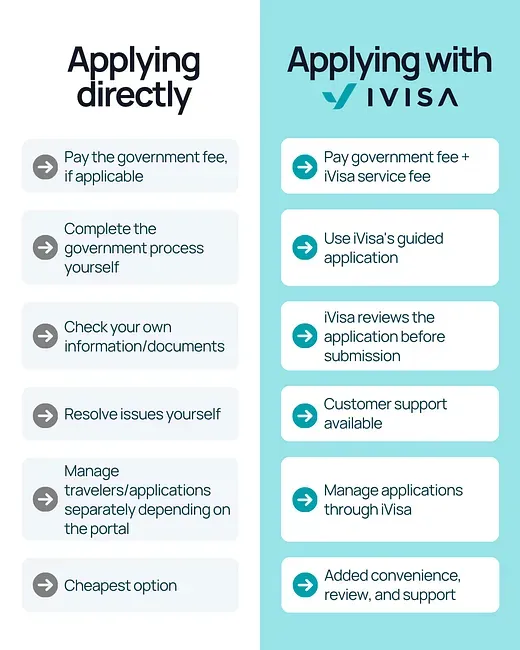
In these cases, the government may provide the document at no charge, but iVisa’s service fee is separate from the government fee and covers the service we provide around the application. It is not a charge for the government document itself. That service includes a shorter, clearer form, a review that checks your details before submission, support in your language if you get stuck, and clear estimated processing and delivery periods.
If you’re comfortable using the government portal and completing the process yourself, applying directly is a valid and cheaper option. When you apply with iVisa, the service fee covers the additional review, support, and convenience we provide throughout the application process.
What does the service fee cover?
To help you decide whether iVisa is a service you want to use for your travel documents, we want to provide as much insight as possible into what the service fee actually covers.
- A shorter, guided form: Travel document applications can involve lengthy forms and unfamiliar terminology. iVisa simplifies the process with a guided form, available in 14+ languages and focused on the information needed for your application. You can also save your progress and come back later.
- A review before anything is submitted: This is at the core of the iVisa service. Every application is checked by software and then by a human, looking for small errors that can lead to delays or rejection, such as a mistyped passport number, mismatched dates, a blank field, or a photo that doesn’t meet the necessary specifications. These mistakes can be easy to make and costly or time-consuming to fix, so the review is designed to catch them before the government sees the application.
- Photo and document handling: Photo requirements can be one of the reasons an application stalls. Rather than having to manage dimensions, backgrounds, and other specifications yourself, you submit your documents and our team prepares them according to the requirements for your application.
- 24/7 customer support: iVisa’s customer support team is available 24/7 via chat, WhatsApp, and email, in 14+ languages.
- Process tracking and a personalized dashboard: Once you have completed the necessary forms, iVisa provides status updates as your application progresses. Your personalized dashboard stores your submitted documents and saves your details, making future applications faster and easier.
- Managing group applications: This is not to be confused with shared visas. Everyone traveling still needs their own travel document where required. However, iVisa lets you manage applications for a family or group together rather than starting from scratch for each person.
iVisa has supported more than 3 million travelers and received 70,000+ Trustpilot reviews, where customers regularly highlight the reassurance of knowing their application was checked and submitted correctly.
What the service actually doesn’t provide
While we have outlined the benefits of using iVisa and the service you can expect for the fee you pay, it is equally important to be clear about what the service doesn’t cover.
What iVisa can and cannot control
iVisa can: simplify the application experience, review information for errors, prepare documents, provide customer support, and track the application where available.
iVisa cannot: change government eligibility rules, guarantee approval, or control how quickly a government authority processes an application.
Once an application reaches the government, processing times and approval decisions are in the hands of the relevant authority. iVisa’s review can help reduce the risk of avoidable delays caused by application errors or resubmissions, but the government ultimately decides the outcome and processing time.
For travelers who want additional protection, the optional Denial Protection add-on refunds both the government fee and iVisa’s service fee if the government rejects the application, whatever the reason for the rejection. It has to be added when you place the order, each traveler needs their own, and the Denial Protection fee itself isn’t refunded.
Once your application is filed with the government, the government fee generally isn’t recoverable because it has already been paid to the relevant authority — Denial Protection is the exception. iVisa’s service fee is subject to iVisa’s refund policy, which is worth reading before you apply.
In short
The government application is and will always be a valid option. Applying directly can make good sense if you’ve completed the same application before and found it easy, your case is straightforward, you have time to resolve any issues, and you’re confident handling the process yourself. And if your nationality doesn’t require a visa or travel authorization for your destination, you don’t need to apply for one.
iVisa may be particularly useful for first-time or more complex applications, group applications, unfamiliar processes or languages, or simply when you want the reassurance of having your application checked before it is submitted.
The government fee covers the government application. The iVisa service fee covers the additional service around it: a shorter guided form available in multiple languages, human review, customer support, application tracking, and help managing the process.
Both routes are legitimate. The point is that you can see exactly what each number is for before you decide.