
Key points
- iVisa reviewed 726,824 finalized applications across 232 nationalities between October 2024 and October 2025.
- Male applicants were 62% more likely to be rejected than women, driven largely by timing and documentation habits.
- Solo travelers faced the highest rejection risk, up to five times higher than pairs and over 20 times higher in the UK.
- Applicants aged 25 to 44 saw the most refusals, while those 65 and older had the fewest.
- Small steps such as applying early and adding proof of return travel measurably improve approval odds.
Visa rejections surged globally between 2024 and 2025. As one of the world’s largest visa processors, iVisa analyzed 726,824 applications to identify who is most likely to be denied when applying for travel documents and why.
While Schengen visa refusal rates have slightly improved over the past three years, US B1/B2 and ESTA rejections have risen by about 10% since 2022, according to the US Department of State. Travelers are also facing increased scrutiny at the border, with inadmissibility decisions at US ports of entry jumping from 380,652 in 2022 to more than 1 million in 2023 and reaching 1.23 million in 2024.
These trends prompted the iVisa data team to review 726,824 finalized visa applications between October 2024 and October 2025, covering 232 nationalities and a wide range of visa and travel documents. The analysis identified three major factors that shape approval odds: gender, age, and group size (especially solo travel). Each insight is based solely on completed government decisions. Applications that were cancelled or abandoned are not included.
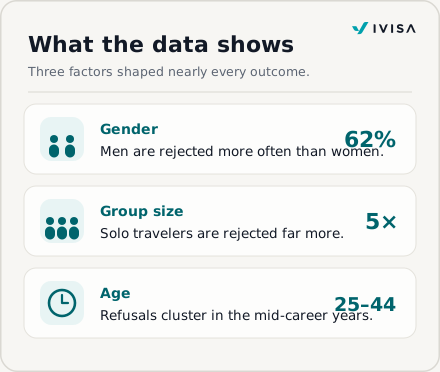
What the data shows
These patterns are consistent across nationalities and visa types. They reflect how preparation, behavior, and timing shape application outcomes.
“People really assume privilege – like ‘I’m from the UK, I won’t have any problems.’ That’s a mistake, especially in the current immigration landscape,” warns former US visa officer Christa Byker.
1. Gender: Men are 62% more likely to be rejected than women
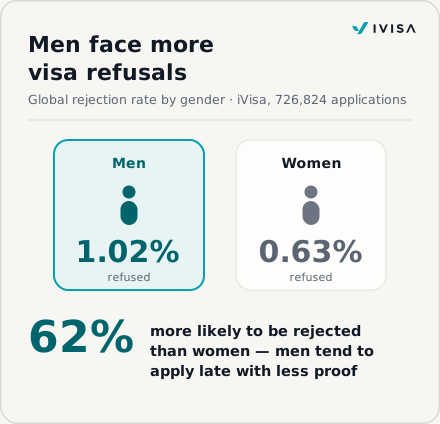
Our data show a clear pattern: men face higher rejection rates because they tend to apply later, submit less documentation, and fall into age groups that receive closer scrutiny.
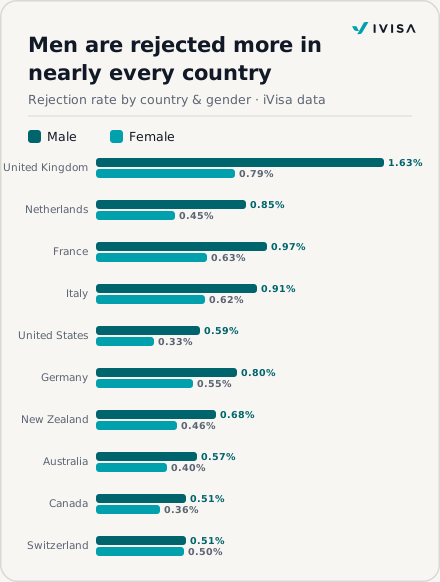
Across almost every country in the dataset, men had higher rejection rates than women. Male applicants were 62% more likely to be rejected, according to internal data. This pattern was most visible in European and English-speaking countries. The United Kingdom and the Netherlands showed the widest gaps.
Real example
A Mexican couple recently shared their experience with the US B1/B2 visa application process. The wife, who travels on an ESTA without issues, was approved, while her 31-year-old husband was denied. Despite bringing proof of income, business ownership, assets, and a full invitation with financial support, none of his documents were reviewed. After a brief set of questions, the officer denied the visa, stating that the purpose of travel had not been sufficiently proven.
Cases like this are not uncommon. Trends show that younger male applicants, especially those traveling with family members who already hold visas or visa waiver privileges, often face additional scrutiny and faster refusals even when they provide strong supporting documents.
Rejection rate by country and gender
The gap holds across nearly every country in the dataset, and it is widest in the United Kingdom and the Netherlands.
Why this happens
Men in the high-risk group (ages 25 to 44) were more likely to submit last-minute applications, skip optional documents, or leave fields incomplete, among other reasons that reduce trust and increase risk signals during the screening process.
“If there’s any confusion based on what you’ve presented, it will just go to denial. They’re not going to waste time trying to figure it out. If they need more time, they send you to a visa interview,” warns Christa Byker, a former US visa officer.
iVisa tip
When applying for visas, it is recommended to apply early, carefully review the details, and include any necessary supporting documents, such as proof of accommodation or return travel arrangements, even if not required.
2. Group size: Solo travelers face the highest rejection rates
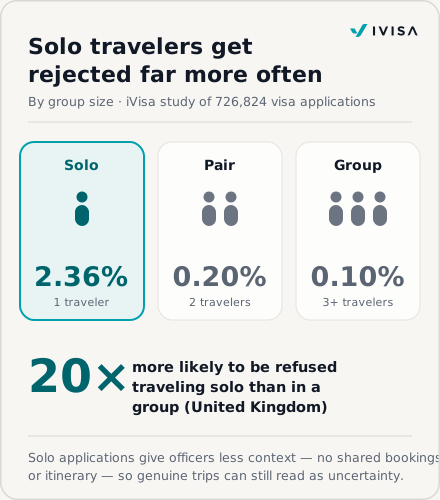
Traveling alone has its benefits, but solo applicants face the highest rejection risk in the visa process of any group. With solo travelers up to five times more likely to be rejected than pairs and more than 20 times more likely in countries like the United Kingdom, group size emerges as a major factor influencing visa outcomes.
The gap is clear across nationalities and visa types. In some countries, the disparity is even more pronounced. In the United Kingdom, solo travelers face a 2.36% rejection rate compared to 0.20% for pairs and 0.10% for groups, making them 12 times more likely to be rejected than pairs and more than 20 times more likely than groups.
France, Italy, Germany, and the Netherlands show a similar pattern, with solo rejection rates between 1.0% and 1.3% versus roughly 0.2%–0.3% for pairs and even lower for groups, resulting in a four to six times higher likelihood of refusal.
The United States follows the same trend, where solo applicants face a 0.71% rejection rate compared to 0.15% for pairs and just 0.02% for groups, making solo travelers nearly five times more likely to be denied than pairs and more than 30 times more likely than group applicants.
Global rejection rates by group size
Real example
Carlos from South Africa described his experience applying for a UK visa: “The first time I applied alone, I was denied even though I felt prepared. A few months later, two friends and I applied as a group for the same trip, and I organized all of our documents. We ensured that our itinerary, hotel bookings, and return flights aligned. This time, all three of us were approved with no issues. It really showed me how applying as a group with a clear and consistent plan can make a big difference.”
Why this happens
Solo applicants often provide less context. Their applications may lack shared bookings, itineraries, or return confirmations. These gaps create uncertainty.
iVisa tip
If you are applying solo, it is always advised to include your full travel plan, especially if the visa you are applying for requires travel details. Depending on the visa you are applying for and the country you plan to visit, remember to include a detailed itinerary, hotel confirmation, return flight details, and the purpose of your travel. This indicates that your trip is structured and temporary, but please note that you should only do this if requested.
3. Age: Younger travelers face more rejections
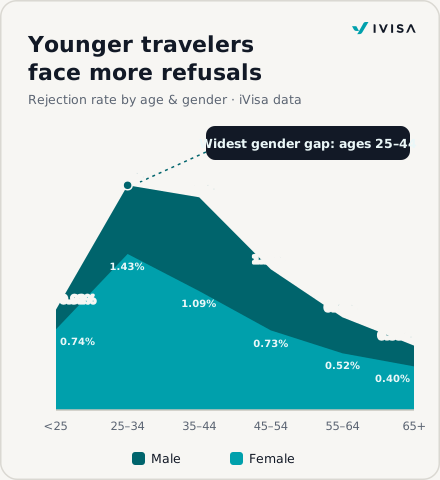
Age is another strong predictor of visa approval, with younger travelers facing significantly higher rejection rates than older applicants. Those aged 25 to 44 consistently show the highest refusal levels, while travelers aged 65 and older experience the lowest, making age one of the most precise dividing lines in visa outcomes.
The gap between men and women is largest in the 25 to 44 age range. This group also overlaps with the solo travel cluster, increasing the odds of rejection.
Rejection rates by age and gender
Why this happens
Younger travelers are more likely to apply close to their departure date. They are also less likely to include optional documents, such as accommodation details, an itinerary, or proof of return. Older travelers usually apply earlier and provide more complete information. That preparation improves their chances of approval.
“We’ve noticed that younger travelers apply at the last minute and often rush their applications and lack adequate travel plans (intend to wing it) while seasoned travelers tend to be well prepared,” explains Ranjini Kurup, iVisa’s Customer Experience Senior Manager.
iVisa tip
Planning ahead and including optional documents makes a measurable difference in your approval odds.
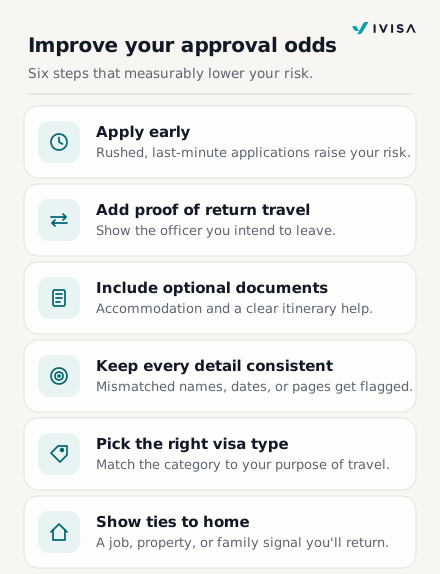
How to improve your approval chances
Small actions can reduce your rejection risk.
iVisa insight
Adding just one extra document, like proof of return, can significantly improve your approval odds. Why? Well, former US visa officer Christa Byker pointed out: “Visa officers are not going to approve your visa if they’re not convinced you’re going to leave [the country]. People really ignore this and just talk about why they want to go. But that’s not what they should be focusing on.”
Here are some common errors people make that are costing them their visa approval:
- Incomplete or inconsistent documentation: missing pages, expired documents, or mismatched personal details.
- Photo or biometric errors: wrong dimensions, poor quality, or non-compliant background colors.
- Financial proof issues: unclear income sources, insufficient funds, or mismatched account details.
- Travel history gaps: missing entry or exit stamps, inconsistent dates, or unexplained prior refusals.
- Incorrect visa type: applicants choosing the wrong category for their purpose of travel.
- Overlooked details in application forms: spelling errors, incorrect dates, or skipped fields.
- Weak purpose of visit: vague travel plans or missing invitation letters.
- Lack of supporting documentation: no ties to the home country, such as employment, property, or family proof.
- Unclear or contradictory information: inconsistencies between documents or interview responses.
- Timing mistakes: applying too close to travel dates or using outdated forms.
What this report shows
Visa approvals are not random and follow patterns shaped by how and when travelers apply. This report highlights three key signals that influence rejections: gender (male applicants are more often flagged due to timing and documentation habits), solo travel (lack of context creates risk, even for genuine trips), and age (younger travelers often under-prepare or apply too late).
While these are not complex rules, the trends are clear across nearly every country and visa type in the dataset. Entry and approval decisions ultimately rest with the relevant government authorities, so travelers should always confirm requirements with official sources before applying.
How iVisa helps reduce mistakes and avoid rejections
Did the data spark increased anxiety? Fear not, at iVisa, we aim to help you prevent these issues by offering:
- Error prevention: Over the past year, our review process identified errors in 17.1% of more than 52,000 UK visa applications before they were submitted for processing.
- Real human support: Our iVisa team provides multilingual guidance and helps applicants when government portals request additional information.
- Help with technical issues: We assist with payment failures, photo uploads, and formatting problems that often occur on official sites.
- Extra reassurance for those who need it: Older adults, non-English speakers, first-time travelers, and applicants with past refusals or complex histories receive clear step-by-step support.
- Simplified process: This includes secure payment processing, status tracking, reminders, and photo correction tools.
In a recent survey, 68% of travelers said iVisa’s support reduced stress or prevented costly mistakes. iVisa is a private travel-document service and is not affiliated with any government. Its service fee is separate from any government visa fee.