
A 60-second check helps travelers catch the most common application mistakes before they pay a non-refundable government fee.
iVisa, a leading provider of travel visa and travel document services, has released the India e-Visa approval predictor. The tool arrives in a week of major announcements about India’s visa rules. Travelers answer five quick questions and get a personalized read on how ready their application is and which mistakes people in their situation most often make. Final decisions on every application rest with the Government of India.
The India e-Visa is an online application that most travelers complete without problems. Once it’s submitted, though, you can’t amend it. A single wrong character in a passport number or a photo that misses the specifications means starting over and paying the government fee again.
The Tourist Visa is becoming the Visitor Visa
On November 11, 2026, India’s Ministry of Home Affairs announced that it has cut the number of main visa categories from 13 to 9 and renamed the Tourist Visa the Visitor Visa. It will now be available in two forms:
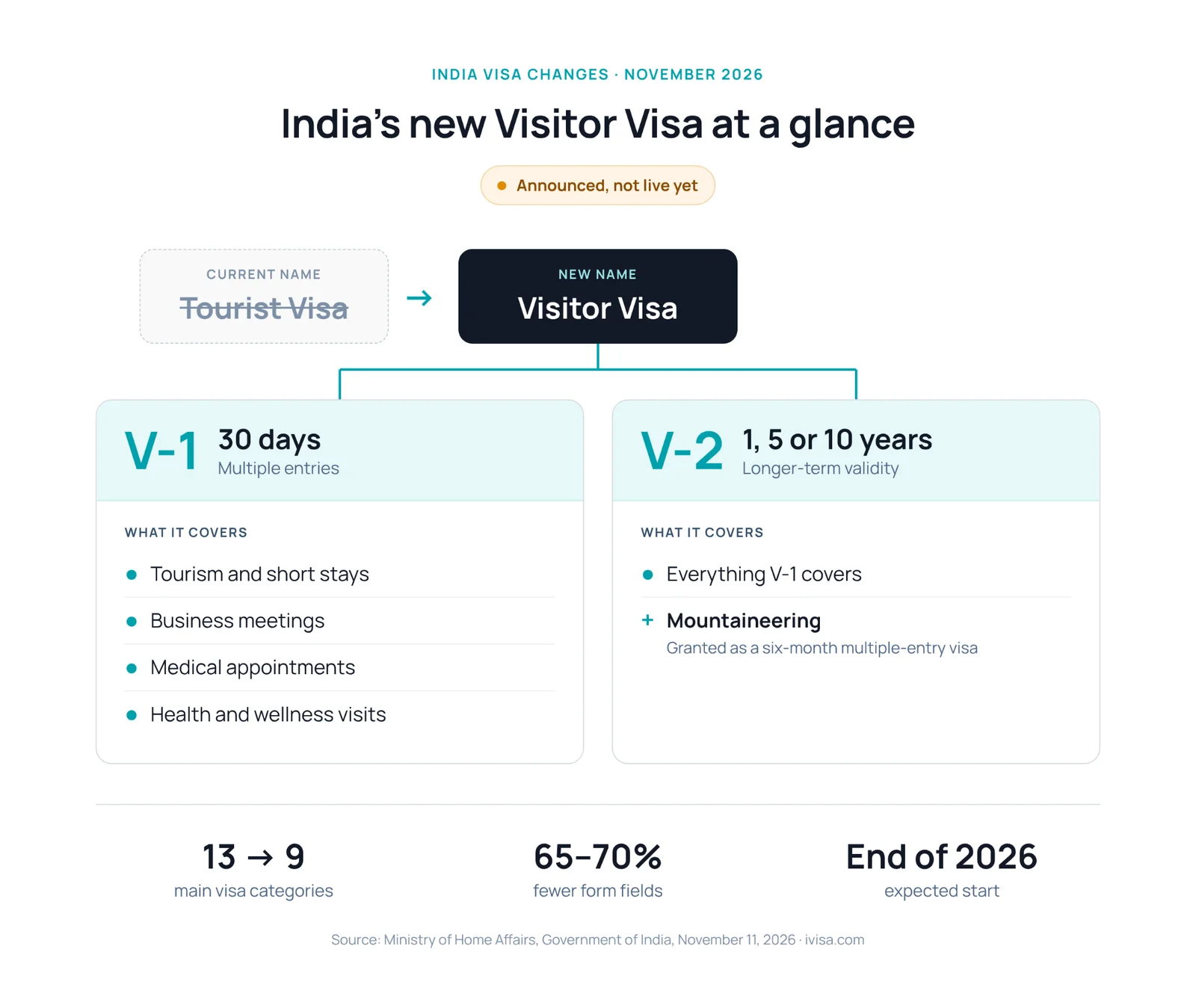
The ministry has also reduced the number of fields on the visa application form by 65-70% and will be issuing visas under the new structure by the end of 2026. It has not yet indicated how today’s e-Tourist Visa will relate to V-1 and V-2 or whether the e-Visa fees will be affected.
Free e-visas proposed for ASEAN tourists
At the 23rd ASEAN-India Summit in Manila on November 17, Prime Minister Narendra Modi proposed free e-visas for tourists from ASEAN countries. No start date has been set. “Free” does not mean visa-free: travelers would still need to apply online before they travel, and only the government fee would be waived.
Some ASEAN nationals already pay no government fee today: Indonesian and Myanmar nationals for the e-Tourist Visa, and Malaysian (until December 31, 2026), Filipino and Thai nationals for the 30-day version.
What applicants need to know today
None of the newly announced changes are on the e-Visa portal yet, so today’s application rules still apply. Under those rules, travelers can apply up to 120 days before arrival and no later than 4 days before. The 4-day cut-off is a hard limit, so applying 1-2 weeks ahead leaves time to fix anything that comes back. Until the new categories go live, most visitors need the e-Tourist Visa (30-day, 1-year or 5-year). Travelers meeting an Indian company need a Business e-Visa, which has different document requirements.
What has already changed: since December 18, 2025, the 30-day e-Tourist Visa can be applied for up to 120 days ahead instead of 30; since June 12, 2026, newly approved 30-day e-Tourist Visas allow multiple entries instead of two; and since April 1, 2026, Delhi airport accepts only the digital e-Arrival Card.
According to official e-Visa rules, the passport must be valid for at least six months from the application date and have at least two blank pages. Journalists and media professionals apply for a Journalist visa instead, and applicants with defense, military, security or police background aren’t eligible for the e-Visa. The form also asks about previous refusals or overstays.
The mistakes iVisa’s review teams see most often
Most of the problems iVisa’s review team catches on India e-Visa applications come down to a small number of easily avoidable mistakes.
- Passport photo: must be a square JPEG (equal height and width) between 10KB and 1MB, on a plain white or very light background with no glasses and no shadows. A 35x45mm UK or Schengen style passport photo is the wrong size.
- Passport details: enter your name exactly as it appears on your passport (including any middle names). Be mindful that your passport number may contain lookalike characters (the letter O and the figure 0, the letter I and the figure 1).
- Passport scan: upload the bio page as a PDF between 10KB and 300KB, flat and glare-free with all four corners and the two machine-readable lines at the bottom clearly visible. Angled phone shots are a very common cause of failure.
- Your reference in India (e.g. your first hotel). If you’re applying via iVisa, you don’t need to provide one.
- Payment issues: if a payment appears to have failed, check the payment status on the e-Visa portal prior to paying again. The government fee is non-refundable once paid.
Can I travel with a partner, friends or kids? Yes, you can, but each individual will need their own e-Visa. A single poor-quality photo can bring the whole group to a standstill.
Don’t forget the India e-Arrival Card
Foreign nationals can complete the India e-Arrival Card online up to 72 hours before arrival, and since April 1, 2026, Delhi airport has accepted only the digital card. It does not replace the e-Visa. iVisa can also assist with the India e-Arrival Card.
On the trip, travelers should carry the following. Airline and immigration staff may ask to see them.
- The passport you applied with. Your e-visa is linked to that.
- A printed copy of your e-Visa approval and one on your phone.
- Your e-Arrival Card confirmation.
- Your hotel’s address.
The official rules also state that you should have a return or onward ticket and sufficient funds for your stay, so make sure you have those details to hand.
“India’s visa rules are changing, but until the new categories reach the e-Visa portal, every application still follows today’s rules. Most of the problems our team sees come down to small details: a photo in the wrong shape, or a letter O typed where the passport shows a zero.” shares Victor Gimenez, Director of Customer Experience at iVisa.
Travelers who apply through iVisa have their application checked by human experts and AI before it goes to the Government of India.
Take our India e-Visa approval predictor for a bespoke read in around a minute. When you’re ready to apply, then go ahead and apply via iVisa. Our team will review your application prior to it being sent off to the Government of India.