

Key points
- Kenya replaced visa-on-arrival with a mandatory Electronic Travel Authorisation (eTA) in January 2024; it must be secured before you fly.
- Most international visitors need one, including infants and children, while EAC citizens and most African nationals are now exempt.
- Applying late is the most common mistake, and low-resolution passport scans or photo issues are frequent causes of delay.
- Travelers combining Kenya, Uganda, and Rwanda can use the single East Africa Visa.
- The Mara migration peaks late July through October; guides suggest at least four nights near the river.
Kenya’s entry system has changed: what you need to know
Kenya no longer issues visas on arrival. Since January 2024, the country has operated an Electronic Travel Authorisation (eTA) system, replacing the previous eVisa platform entirely. If you’ve read anything about Kenya visa requirements that pre-dates that change, set it aside.
The Kenya eTA is a digital entry permit that must be obtained before you travel. While Kenya is technically “visa-free,” the eTA is a mandatory paid authorization that functions similarly to a visa. Attempting to arrive without one is not possible: airlines are required to verify documentation before boarding, and not having an approved eTA may result in denied boarding or complications on arrival.
Who needs a Kenya eTA: Most international visitors, including tourists, business travelers, and those visiting family. This includes infants and children, each of whom requires a separate application.
Who is exempt: Citizens of East African Community (EAC) partner states (Tanzania, Uganda, Rwanda, Burundi, Democratic Republic of Congo, and South Sudan) can enter without an eTA for stays up to 180 days. Following amendments in May 2025, most African nationals are now also exempt from the eTA requirement. Citizens of a small number of countries with bilateral agreements are also exempt.
How to apply for the Kenya eTA
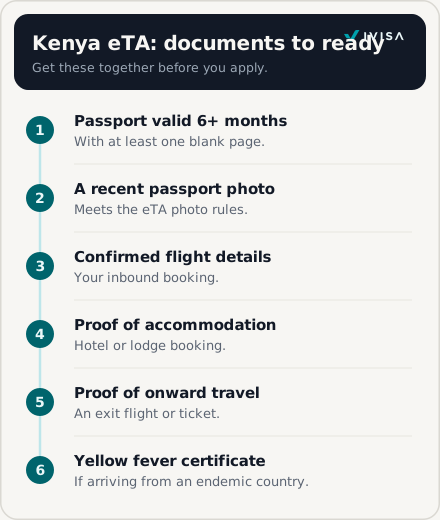
You’ll need a passport valid for at least six months beyond your arrival date with one blank page, a recent passport photo, confirmed flight details, proof of accommodation, and proof of onward travel. A yellow fever certificate is required if you’re arriving from an endemic country.
The eTA is not a guarantee of entry. That determination is made by immigration officers on arrival.
“The most common mistake isn’t misunderstanding the rules, it’s leaving the eTA too late,” according to Victor Gimenez, Director of Customer Experience at iVisa. He noted that during peak season, delays are most probable, and “a passport scan that’s low resolution or poorly cropped can hold up an otherwise straightforward application.”
Multi-destination travelers face additional complexity. Combining Kenya with Tanzania, Uganda, or Rwanda means separate requirements for each country. If your itinerary includes Kenya, Uganda, and Rwanda, though, the East Africa Visa covers all three on a single permit, which simplifies the process considerably.
Where iVisa helps
Many travelers apply directly through the official government portal without issue, and for those who prefer to manage the process themselves, that remains a perfectly reasonable option.
That said, the Kenya eTA system is relatively new, and in practice it has introduced friction that isn’t always obvious until you’re mid-application. Some of the most common issues applicants face are:
- Payment failures: the portal uses a background verification step during checkout that many cards cannot complete, not because of insufficient funds or incorrect details, but because of how the portal’s own payment system works.
- Photo rejections: the requirements are strict but poorly explained, and automated error messages rarely indicate what needs to change.
- Website glitches: some applications stall in processing without updates, leaving travelers uncertain about whether anything is actually progressing.
iVisa, a private travel-document service, can help you avoid that uncertainty in a few situations:
- Time pressure: if you’re applying close to your departure date, or if something has gone wrong with a first application, professional support to catch errors and move the process along has practical worth.
- Multi-destination complexity: combining Kenya with other East African countries means multiple applications, different requirements, and different fee structures. Managing that across a single service reduces the risk of overlooking something.
- Unfamiliar documentation requirements: for first-time travelers to the region, or for nationalities whose requirements are less straightforward, guided support can reduce the risk of a document error that triggers a delay.
- Confidence and accountability: some travelers, particularly those who’ve had a difficult experience with government portals before, simply prefer the security of having a verified application reviewed by people who process these daily.
Note that iVisa charges a service fee on top of the government’s eTA fee. Both amounts are shown before you pay, so you can always compare against applying yourself on the official portal.
Practical tips for your Kenya trip
For most international arrivals, the entry point is Jomo Kenyatta International Airport (JKIA) in Nairobi. From Nairobi, travelers reach the Masai Mara either by road (approximately five to six hours to the main reserve) or by light aircraft to one of several airstrips within or near the reserve, including Ol Kiombo, Mara Serena, and Keekorok.
The migration’s peak window in the Mara is broadly late July through October, with August and September considered the highest-probability months for Mara River crossings. That said, crossings follow rainfall and animal behaviour, not tourism schedules. Allow enough nights in the reserve to give yourself a realistic chance; most guides recommend a minimum of four nights near the river.
Before you go: documentation checklist
The Masai Mara in migration season is one of those trips that stays with you, and getting there takes planning: the right camp, the right dates, enough nights near the river to give yourself a real chance at the crossings. The documentation shouldn’t be the part that unravels it.
Kenya’s eTA system is manageable if you approach it with enough time and the right information. Apply early, get your documents in order, and know what you’re walking into. Requirements can change, so confirm the current rules for your nationality against official sources before you travel.
Whether you go directly or use a service like iVisa, the goal is the same: to arrive at the Mara with everything in order and nothing left to worry about, except what’s happening on the other side of the river.